Wednesday, 14 September 2016

Fires On The Beach & Devils In The Dark - Tasmania part 2


'Charlie' Boorman got a beer at the Pub in the Paddock
The Pub in the Paddock gradually disappeared in the mirror. Heading east towards the seaside town of St Helens I was marvelling at the fact that ‘Charlie’ Boorman had been able to get a beer at the pub and I couldn’t. It kept me amused for a few kilometres.
 
The Tasman Highway was an easy ride. The road, like most in Tasmania, was in great condition, winding its way through ancient eucalypt forests and picturesque farm lands. In no time we were in St Helens, I was still struggling to get my head around how close everything is in Tasmania.

The largest town on the north-east coast of Tasmania, St Helens is a Mecca for tourists of all sorts, especially those interested in fishing and seafood, apparently the surfing is good too. On this occasion it was just a quick stop for us as we ventured a little further north, a chance to see one of the most unique coastlines that I have seen for a while.

A beach on fire ... Vibrant colours of the Bay of Fires
The coast road north led us to an area known as The Gardens. Dismounting at the end of the bitumen I wondered if we could continue further north, deeper into the area known as the Bay of Fires. We could, we didn’t, there was no need. A quick glimpse over the dunes gave some indication as to what was in store.
 
The sand was so fine, so white. It didn’t look real. It squeaked when walked on. I had no doubt that this was where the sand for hour glasses was sourced. Contrasting against the brilliant white was the richest orange. The rocks protruding from the sand looked ablaze. I looked south and was stunned to see the whole coast on fire. We made a decision to return south and explore the brilliant site.
 
What we had found was essentially the middle point of the Bay of Fires, or Larapuna in the local indigenous language. The most amazing oranges and reds framed by the brilliant white sand, it stretched for miles to Binalong Bay in the south and Eddystone Point in the north.
 Viewed from out in the perfect blue waters of the bay it would be easy to see why the area had been named the Bay of Fires however, I quickly learnt that it was named in 1773 by Tobias Furneaux in the ship Adventure who apparently saw the coastline dotted by fires set by the local Aboriginal people. I couldn’t help but think had he actually mistaken the orange stones for fires.
 
The stones, of all sizes, that line the beaches are granite and in fact get their brilliant orange colour from the lichen that adorns them. There were tourists here but not enough to be annoying, it felt remote, secluded, and inviting – had the weather been a little warmer I would’ve stripped out of my sweaty adventure gear and gone for a dip in the turquoise waters. I wanted to pitch the tent in one of the many beachside areas set aside for camping. Impossible! They were all taken. 
 
We continued south to Binalong Bay. A photographers dream, this small coastal town was voted by Lonely Planet in 2008 as the number one global holiday destination. I could see why, yet it wasn’t spoilt by over development or tourism, in fact I felt that it was very similar to the Town of 1770 in Queensland. I felt I’d like to spend my last days in a place like this.
 
Completing a loop of the town we decided we would head further south. We again passed through St Helens and joined back on to the coast road. I’d been warned that while it was quite a good ride there wasn’t a lot to look at. Rubbish! As with all coastal roads you need to know what to look for, enjoy the natural beauty, the history. There was plenty to see here, at times too much to take in.
Iron Horse Brewery ... great beers!
Passing through a small settlement called Four Mile Creek we were soon upon an impressive, modern looking building in the middle of fields. I slowed to get a better look and was almost knocked off my bike by the most beautiful of billboards. Iron Horse Brewery. Beer! Just what the mid-afternoon was calling for. We pulled in. I was off my bike and through the doors in no time. The place came as a shock. It didn’t feel like a brewery. Sterile and lacking atmosphere. Thankfully the tasting paddle was just what was needed, and the beers on sample were all of the highest quality. I was able to cram a six pack into one of my panniers.
 
Back on the road we were determined to make it to Bicheno, the so called jewel of the east coast, to see the Tasmanian Devils. We were in luck, we were able to join a night time feeding session of these endangered marsupials, but before that we had bikes to see … and lots of them.
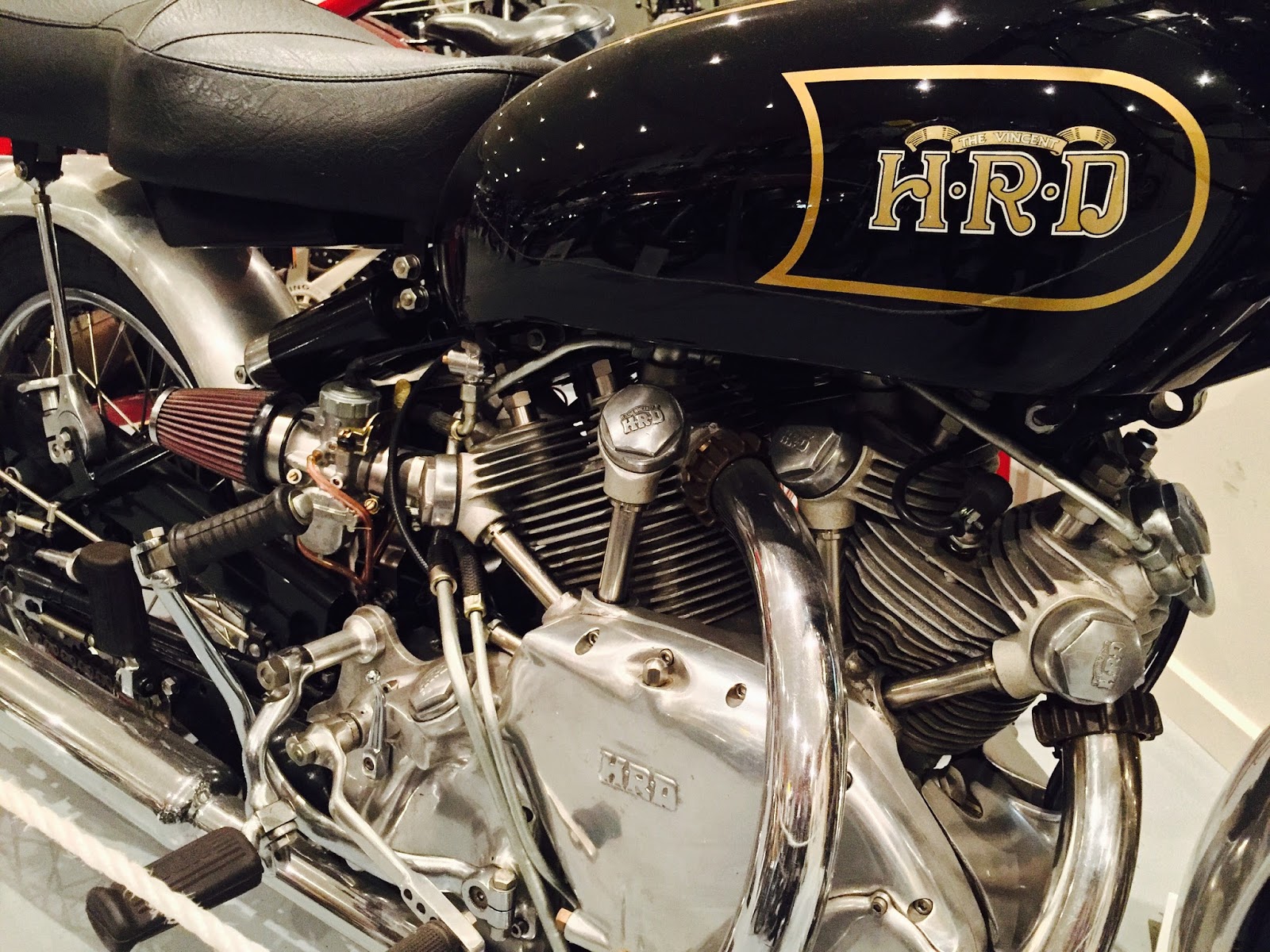
$80,000 bike ...
The Bicheno Motorcycle Museum is considered one of Australia’s best. A private collection of over 50 bikes of all eras, styles and makes. This is a great collection. Walking through the door I stood in stunned silence as a HRD Vincent was the first bike on display - $80,000 worth and just sitting there, unbelievable.
 
Dinner was had at Pisini’s Italian Restaurant. My god, did we eat. The food was brilliant and service was great. That was the amazing thing about Bicheno. It’s a tiny town yet has worked well to cater to the tourists, plenty of restaurants and bars, and a great atmosphere.
Got to love the Italian style ... Bicheno bike museum

Filled to brim with great food we waited for the tourist bus to pick us up and take us to the ‘secret’ location where the Tasmania Devils are fed. Although in the dark it was an enjoyable 30 minute drive. A family of Americans were amazed that we were riding motorbikes around the island; they were even more amazed when we told them this was a short ride. We all laughed when one of them spotted a small kangaroo by the roadside and we told them that the things often jump straight out at you – it makes riding a bike a little more exciting.


We soon arrived at the location designated by Devils In The Dark. Night provides an opportunity to see the carnivorous marsupials feeding in their natural habitat, the humans enjoyed wine and cheese. It was a chance to learn about them and the issues that could force them into extinction. Many think of the Tassie Devil as the crazy Looney Tunes character spinning wildly into the scene yet they face a very serious problem of facial tumours that are threatening their very being. A number of Tasmanian institutions are trying to combat the problem through isolation and genetics, Devils In The Dark is one such organisation doing a great job.
Devilish little characters
 
The experience ended after a few hours. I felt humbled; to see these noisy little creatures at their best and knowing that my little time with them might help them survive. It was gratifying. Touristy, yes! Important, very much so!

The following morning started early. The plan was to get to the Freycinet National Park and walk some of the wilderness trails. We were early, in fact early enough to be the first people there. It didn’t help, we went the wrong way, headed down the western side of the peninsula, at this time of the morning it didn’t matter, later in the day it would be murderous.

We headed off, with some good sense to ditch all of the riding gear, although Kevlar jeans did make it for a hot walk. Fourteen kilometres of climbing and scrambling was great and the scenery amazing. It became apparent quite early that this was still a tourist walk, and littered with all sorts of human waste – the amount of dumped tissues and toilet paper was appalling. I was told it was a cultural thing. We kept up a cracking pace and after around 2 hours found ourselves crossing the thin neck of the peninsula towards the east. In this small area there had already been so many scenery changes brought on by the varying landscape and environments – everything from rugged cliffs, to lush rainforest, sandy beaches, swampland and even an area that looked like it was from a nuclear holocaust – obviously a fierce storm had been through here.

Wine Glass Bay, without the tourists
The eastern side revealed the ‘magnificence’ of Wine Glass Bay. Often said to be one of the world’s most beautiful and ideal beaches, I was underwhelmed, perhaps jaded by the now hundreds of tourists that were spoiling the natural beauty. The climb up and over the mountain that protects the beach was torturous, yet rewarding, especially when a friendly little wallaby came over to look at our bikes at the end of it.

You can never have enough seafood
We continued on around Coles Bay. I knew there were oyster farms around here yet what appeared next was pure joy. Freycinet Marine Farm. As much fresh seafood as you can image. It didn’t matter that I’m allergic to crustaceans there was plenty of everything else. We sat with a couple from Tasmania while eating oysters, mussels and drinking beer. Heaven! The couple were envious of what we were doing and pointed out a few things that were ‘musts’.

Venturing around Moulting Lagoon we were soon heading south again. No real plans of where to stay, mindful that it was getting late. I was happy to pitch the tent in the wilderness, it didn’t happen. Heading towards the village of Orford we came across one of the ‘must’ sees, the Spiky Bridge.
 
The bridge used to be a part of the main road, now it sits adjacent, almost looking ridiculous as it appears to be in the middle of a paddock. Built in 1843 by convicts, no one can really explain why it has spikes built into it. The entire main span of the bridge is mortar free, constructed from field stones laid on top of each other in much the same way that drystone walls are built. The spikes too are field stones that have been placed upright into mortar on the parapets. It’s believed that the spikes are there to prevent cattle from walking over the edge, no one can confirm this, and it does seem a little farfetched. The uniqueness of the bridge is reason enough to stop and have a look.
Spiky Bridge

Orford, just another 50km down the road was a welcome site, by now we were becoming exhausted. With a population of just over 500 accommodation was limited, we plumped for a 1960’s looking motel adjoining the pub. At least the walk home wouldn’t be too far. The rooms were surprisingly good, very spacious and certainly comfortable. We settled in.

The Blue Waters Motel, looked like it was going through a major renovation. Perhaps more resort style is what the owners are looking for. It would take considerable work to achieve the desired, the pub part of the alterations was certainly working. We ventured inside for dinner. A few patrons and guests were already seated. The huge dining area didn’t look like anything special. With orders placed we sat with a few beers and started talking about the history of Orford …

Sudden darkness was accentuated by the Hollywood sound effect of power going off. The bar staff scrambled around trying to work out what had happened. The restaurant manager was quickly on the phone. It turned out there had been a nasty accident down the road which had taken out a power-pole, we sat and waited and continued to discuss the history.

The town was settled in 1831 to service the nearby Maria Island penal colony. The jetties still remain despite the water being too shallow for larger vessels. A quarry which is still in use today provided many stones for buildings in nearby Hobart as well as those in a number of prominent Melbourne constructions. Today the area service tourists with its pristine beaches.

Power came back on; we ate and then made the short walk to bed. Tomorrow would be, for me, one of the highlights of exploring Tasmania …

Friday, 9 September 2016

Looking For That Elusive Pub - Tasmania part 1

As day broke we knew we were close to the coast of Australia’s island state, there were no visible signs just the pungent smell of burning eucalyptus. With a quarter of the state burning in summer bushfires the smoke cast an eerie pall over the coast, we knew we were close we just couldn’t see it.

The Spirit of Tasmania sailed down the Mersey River to our departure point of Devonport in the north of the state, eight days had been planned to see the state, at least the east coast. No set plan. Just ride. See what adventure would be thrown our way. Tasmania, the size of Ireland or West Virginia in the USA surely a week would be enough.

Riding the bikes from the bowels of the red and white overnight ferry we were greeted by what looked like a large country town. It was a Saturday and strangely quiet. It didn’t matter the plan wasn’t to spend time here, just head south down the Bass Highway to the town of Longford, a former home of the Australian Grand Prix, and for a Formula 1 fan, such as myself, this was a must.

The original Longford motor racing circuit.
In the 1950’s and 60’s the best motor racers from around the world would visit the unassuming town to take on its 7.2km roughly triangular track. This was the home of not only the Australian Grand Prix but also the Tasman Cup and numerous motorcycle races.

The remains of the track, if you can find them, are a sad reflection of what was once Australia’s fastest racing circuits. It now lies in ruins, and for the most part is no longer visible. A highlight is the Country Club Hotel with its Lex Davison bar. Located on one of the circuits more famous corners it houses a great photographic history of the racing and the many champions, Davison being just one of the local champions.

After a beer it was time to head north to the larger town of Launceston. This wouldn’t be a stop just waypoint as we headed towards the town of Beaconsfield.

Launceston came as a surprise. It was much larger than I anticipated, littered with many colonial buildings, some in pristine condition. I felt a pang of sadness that we had decided to pass through … it meant we would need to come back at some stage.

Beaconsfield. A great history in social and industrial Tasmania
Heading north, Beaconsfield is just 43km along the Tamar River but might as well be another world. Although the roads were good, very good, the landscape changed to a collection of craggy outcrops amongst the thick eucalypt forests. It was rugged, hard country yet something drew the early Tasmanians to this area. Gold! And lots of it.

The area was first settled over 200 years ago, and while limestone mining was the staple it was the discovery of gold in 1862 that lead to the population increase. The town flourished, the population grew, Beaconsfield was on the map yet it was events many years later that keep the town forever in the minds of many people.

At around 9:30pm on the night of April 25, 2006 a small earthquake struck the area around Beaconsfield and triggered a rock slip within the mine, which now spread beneath the town like the roots of a giant gum tree. The collapse buried three miners, killing one instantly, Larry Knight was 44. The two others were saved by the vehicle they were working in and although buried under tonnes of stone they were able to free themselves and hope that help would soon arrive.

In a rescue that held the attention of the entire world the two miners were freed 14 days after the initial collapse, amazingly both were in quite good health and walked from the elevator that had brought them to the surface. They punched the air, switched their mine tags to ‘safe’ before embracing their families. Yes, it was a little staged however, had the effect that the town would now need.

The mine was soon closed due to safety concerns; Beaconsfield transformed itself into a tourist hub. People interested by the story come from far and wide, and those with an interest in the band Foo Fighters, like I, also visit to put a place to the song Ballard of the Beaconsfield Miners.

Spending almost an entire day here it was now time to move on and find accommodation before it got too late. George Town, 44km around and on the other side of the Tamar River was the destination. The ride was fantastic, again on great roads and through picturesque bushland. With a population 7 times the size of Beaconsfield we expected more of George Town, apparently large by Tasmanian standards. Settled in 1802, George Town is also one of Australia’s oldest European settlements.

The history in the area, both human and natural, is spectacular but you do need to go looking for it. This was to be our last night with a chance of some extravagant civility for a while so we lapped it up and booked into the impressive Peppers York Cove. A multi roomed apartment overlooking the cove and nearby town was just the thing. Were we getting soft?

George Town.  Full of history.

We awoke to a fantastic view across the cove with its many small yachts and fishing vessels. Over breakfast a plan was formulated that we would head east through the high country to a town called Pyengana and its famous ‘Pub in the Paddock’.
 
Initially we followed a number of ‘B’ roads through farmlands of varying types. The mid-summer sun was warm and inviting, not too hot, cooling in the higher the altitude. The roads led us to a number of attractions that this area is famous for; food, wine and beer. Berry farms seemed to be everywhere and who could resist? Wineries too, my god, this was dangerous … wine and bikes … not ideal. We did stop at one and soon decided we weren’t feeling welcomed, we were looked up and down by the young lady conducting the tastings. Dirty adventure bike gear not being to her liking.

One of her customers followed us out and soon began discussing our ‘adventure’ he made it clear he was envious and would rather be joining us than spitting out good wine. We laughed and continued on.

Great tracks abound in the wilderness of Tasmania
The road east continued and soon we found ourselves confronted with gravel. The stuff looked glorious, and on roads that were far too daunting for many, if not most, tourists we knew we would be on our own. Tight, twisty and in some places slippery, it was the heaven we had heard so much about in Tasmania.

This land was sculptured by many creeks and rivers and it seemed that no matter where we looked, there was another one providing greater views. Many of the watercourses would culminate at areas such as St Columba Falls. After a short stop it was time to continue on, by now the weather had started to look a little dark, it was possible we would get some rain. This would’ve been a great place to camp.

Riding out of the forest we were greeted by the inspiring site of picturesque dairy farms nestled amongst a beautiful valley. It had that smell, the smell of fertile land and happy animals. It felt welcoming. It was home to the Pub in the Paddock.

Entering the driveway we were amazed by the site of caravans and motorhomes. "Bloody hell," I thought. "Please don’t let this be a favourite with grey nomads."

Pulling up to where the vehicles were parked I couldn’t wait to enjoy a beer. Dismounting the bike, a couple, perhaps in their 60s, quickly pointed out that the pub was closed. What? How could this be? One of the most iconic pubs in Tasmania and it was closed at 4:15 on a Sunday afternoon. This was a problem, not only did I want a beer, we wanted accommodation and now both were denied.

Slapped with this news we stood around unsure of what to do, the town was just down the road, surely we could get accommodation there.

"Hey mate, do you have a tent?" one of the caravaners questioned. Of course we did, but I didn’t really feel like pitching it, by now it had started to rain. We had food, cook in the bag stuff, and water too. I really wanted a beer and a good cooked meal. I continued to make. I was keen to move on.

"Well get it set up," demanded the man’s wife.

"You are having dinner with us tonight."

"What’s going on?" I thought. We’d been here for just a few minutes and we were already being invited to dinner, we hadn’t even introduced ourselves. It was hard to refuse such generosity and while we sat on our bikes looking at each other we felt compelled to stay and enjoy the hospitality.

Despite our mud covered riding gear we were invited into one of the ‘vans and enjoyed a perfectly cooked roast dinner. A man in the van opposite even provided a cold beer. The XXXX, not my favourite, was gone in seconds. I wanted another but was ashamed to ask.

It rained most of the night at the Pub in the Paddock
Slipping into my sleeping bag and drifting off to sleep much earlier than I normally would I woke up well before daybreak. The rain had stopped, a steamy fog hung above the ground. I couldn’t resist grabbing the camera and walking into the fog laden valley. The rich smell of farming hung in the air; cows watched me with interest, undoubtedly wondering why I was interrupting their ideal morning.

Returning back to camp, I was greeted with a breakfast of cook in the bag porridge. It wasn’t too bad. Then was given a tour of the pub by the owner. We were told that she heard that a few bikes had come in and then left, and if she’d known that we’d stayed she would’ve opened up for us. Bugger!

The history of the place is quite unique; I hope to god I’ve got this right. Back in the old days, the pub has been licenced since 1880, a traveller was helped by the patrons of the pub. Suffering from a big night he left early the next morning promising to repay the publican for his generosity, the only promise was he couldn’t remember the name or location of the pub. He simply addressed his repayment to "The Pub in the Paddock", Tasmania. Amazingly, the postal workers of the day knew what he was talking about (St Columba Falls Hotel) and were able to deliver the package … and so the Pub in the Paddock was named. The pub is literally in the middle of a paddock, you see, in its original form it was the homestead for the local farm.
 
Marvelling at the history of the place and vowing to return, we packed, thanked our new friends for their generosity, and continued on into the Tasmanian wilderness …
 

Monday, 25 July 2016

A Little Spot Of Reassurance - Spot Gen3 Emergency Beacon

"I wish all travellers out here would carry one of these", remarked the police officer trying to comfort me in the midde of the Australian outback.
 
Sixty kilometres from the nearest community, and 1000 kilometres from the nearest hospital able to deal with my injuries, without a Spot Gen3 it would've been like tryng to find a needle in a haystack locating a fallen motorcyclist somewhere in the expanse of Australia's Great Victoria Desert.

Within minutes of being thrown from my bike, my fellow riders were able to activate the 'SOS' button on the Spot Gen3, sending a GPS based message through communications satellites to the GEOS Rescue Co-ordination Centre (in the United States) who inturn immeditaley contacted the Australian Maritime Safety Authority, based in the capital city of Canberra.
 
Apparantly all distress beacons go through a countries national authority so as to make sure everything is co-ordinated from the one authority.  AMSA, once they had my co-ordinates were able to pinpoint where I was, where the closest emergency services were located and send help.
 
Within 45 minutes of pressing the emergency beacon both the police and ambulance services had arrived and were offering assistence.  The information provided by the Spot was also able to help them determine whether an aircraft would be able to land to extract me from the scene. Had one of the riders needed to return to the nearest town and alert the authorities we would've been looking at least 2 hours.
 
While the Spot was great and helped with the rescue, a few key lessons were learnt, some which I believe all adventurers, whether on motorcycles or not, should consider. 
 
My Spot always travels in my tankbag, while friends have theirs mounted to the bikes handlebars.  In this instance both would've been useless.  My 260 kilogram fully loaded BMW F800GS flipped a number of times before landing on top of me.  I was pinned under the bike, only able to move my left arm a short distance.
 
The handlebars were destroyed along with everything associated with them, had I had my Spot mounted there it would no longer have been in reach.  My tank bag had been ripped from the bike and was laying around 30 metres away, I couldn't get to the Spot regardless.  I had a lifesaving tool yet was unable to use it.  Had I been on my own, in this extremely remote area, pinned under the bike with broken bones and spinal injuries the situation could've been fatal.
 
The Spot Gen3 comes with a carabiner and strap, designed to be attached to your person.  The device itself weighs around only 120 grams, and is no larger than the smallest mobile phone.  Fix it to your jacket, somewhere it can be reached regardless of the situation.
 
Every motorcyclist who does some form of riding off the beaten track should have a Spot Gen3, it is so much easier than tryng to fumble around with a satellite phone or worrying about cellular coverage in remote areas. And while there's plenty of mobile apps that provide GPS coverage do they actually allow an emergency beacon to be activated and then sent to real emergency authorities?
 
For the small cost of the device (around AU$200)) plus an annual subscription of a similar cost, the Spot Gen3 is great peace of mind anywhere in the world, and could be the difference between life and death.
 
More information - www.findmespot.com

Saturday, 16 July 2016

Accident Scene Management

First Aid For Motorcyclists
 
My helmet was twisted on my head, I couldn't see out of my right eye, it felt gritty.  The helmet, at 45 degrees to where it should be, was crushing my nose, restricting my breathing.  Instincts kicked in and I fought to remove the helmet but as I was pinned under the fallen bike there was no hope.
 
The other riders were now with me and I needn't panic, two of the three had done a first aid course, they would assess the situation and make it right.  What gave me greater confidence was that they had done one specifically designed for motorcyclists.
 
Yes, there was panic amongst my fellow riders as they initially assessed the situation, we were in the middle of the Western Australian outback, desert; hot, dry and very remote.  As they took stock of the situation the panic subsided and a rescue plan was put in place.
 
My initial reaction was get my stricken bike and gear from the road.  Although remote, and very rarely used, the gear spread across the road could cause problems for other traffic, I'd noticed a roadtrain about 50 kilometres back, and if that  came upon us, it wouldn't be able to stop in time.  The rider with no first aid experience was put on this task immediately.
 
The first aiders then set about me.  They could see I was struggling with the helmet, and although I desperately wanted it off, they calmed me and explained what they were going to do.  They essentially looked for a response and obtained a history of the incident.  I knew I had broken my collarbone and was able to convey this to them, they checked for other injuries, especially breathing and then bleeding.  Once they were happy with the situation they set about removing my helmet.
 
In removing someone else helmet there's a knack to it, it is NOT just a matter of pulling it off.  Thankfully they were able to extract it in a way that would prevent spinal damage (although, in hindsight, they probably shouldn't have removed my helmet until the emergency services arrived).
 
The helmet now off did allow them to provide further first aid, and as I started complaining about numbness on my rightside, and started speaking incoherently, the emergency beacon was activated.  From now it was a case of keeping me stable and comfortable while help was on its way.
 
While my two helpers, with the help of my training too, were able to put my arm in a position to reduce the pain, my head was also kept immobilised so as to reduce further risk of spinal injury, this was a concern with the numbness being experienced.
 
A travelling nurse was then on scene and backed up what my fellow riders had done by going over the process again although, with greater detail.  I felt much more relaxed.
 
The outcome of the accident hasn't been great, I've written enough about that however, without the first aid training that three of us had I'm certain it would've be much worse.  The training we had undertaken just a few months earlier was motorcycle specific, teaching things that normal first aid courses don't.  Assessing the scene, removing hazards, 'diagnosing' the condition of the patient and implementing a plan to secure the scene.
 
There's no doubt that one of the greatest parts of this course was the removal of the helmet.  Should it have been removed in my case?  Probably not.  It doesn't matter, it was removed safely, minimising any further damage.
 
Our training, invaluable and which I believe every motorcyclist, especially those that travel and explore remote areas, should undertake to learn, was provided by First Aid For Motorcyclists.
 
www.firstaidformotorcyclists.com.au
An Australian based company, specialising just in motorcycle accident scene assessment and management, First Aid For Motorcyclists has a team of highly trained professionals that not only have the medical skills to pass on to others, they also ride motorcycles and know exactly what is required in these stressful situations.
 
Having undergone many first aid courses over the years, I thought what more can I learn.  Putting aside my arrogance, I realised there was more I didn't know than what I did. 
 
The knowledge I gained from the course was enough to enable me to work with the other riders, providing the confidence to ensure the risks were minimised.  For this, I can't thank Trace Hughes and Roger Fance enough for what they tought me and my fellow riders.
 
If you ride or have a loved one that does, I can't recommend a motorcycle specific first aid course enough.  And if you're able, do one of the best ones around, the sort provided by First Aid For Motorcyclists
 
First Aid For Motorcyclists
Ph +61 0408 956 435

Monday, 11 July 2016

Putting Your Best Foot Forward

A Comparison of Three Adventure Riding Boots

Motorcycle boots are one piece of riding gear that many riders don't even think about.  Casual boots, sneakers and even thongs (flip flops) are often used, the rider believing that a sturdy pair of shoes will protect their feet from the elements and perhaps even in the chance of an accident.  God knows what the rider wearing thongs thinks ...
 
The truth of it is that boots are a very important part of your riding gear, has anyone seen what happens to a footpeg when a bike slides?  If you haven't, check out YouTube and then imagine what would happen to your foot without the right boots.
 
While there's many things to consider when choosing the right boots for the adventure rider there's even more, the boots must not only protect in the case of an accident and also from the elements, they must also offer high levels of comfort.  An adventure rider can spend all day on a bike and often stood on the pegs, the boots need to be waterproof and yet allow the feet to breath.  They must also be comfortable off the bike and allow the wearer enough freedom to walk, often great distances.
 
Obviously choosing the right boot is a very personal choice, with many things to consider however, I'll offer my opinion of three boots that I've worn, all within the mid-price range.  All have there own strengths and weaknesses, and while this is not an endorcement of any, one is clearly my favourite and will probably take some beating.
 
The RST Adventure is the cheapest in the range with a price tag of $AU250.00 and in many ways this is reflected in the quality of the boot.
 
The overall look of the RST Adventure is quite good, a full leather upper (Nubuck, top grain cattle leather) should be enough to highlight the quality of the boot however, it comes with a polyurethane (PU) coating.  This gives the boot an almost plastic or vinyl look, offering a cheaper appearance.
 
The outer is reinforced in a number of areas and these do offer protection to the boot itself, noteably in the area where gear changing can cause excess wear. 
 
Rider protection comes in a number of forms.  A one piece moulded heel cup, and PU shin, heel and ankle reinforcements are the main areas to protect the riders feet.  These actually do seem a little flimsy and at the very least I was always wary that at the very least a twisted ankle could be just around the corner. 
The RST Adventure at the outset looked like it had a very good sole.  Designed to not only grip the bikes footpegs in all sorts of conditions but to also offer a stable footing when walking.  The construction is of vulcanised antislip rubber and does indeed look like it's up to the job.
 
Wearing the boots they do feel comfortable.  They are easy to put on, fastening isn't an issue with two heavy duty metal clasps attached to plastic ratchet buckles, these hold the boots snug and can be adjusted to fit any sized foot and lower leg.  The upper part of the boot which, is quite low on the leg compared to other adventure boots, is fastened with a velcro cuff.  This works well however, the height of the boot doesn't when needed to protect the upper shin from hard objects being thrown at it, this is often the case on gravel or stony tracks.  The shortness of the boot is also a problem when traversing water crossings, either on the bike or on foot.  This is a pity as the boots, as promised are waterproof, as long as you don't any deeper than your ankles.  The waterproofing comes mainly from the Sinaqua lining.  This does keep the boots inner dry however, it is said to be breathable, based on the amount of sweat that often came out with my feet I very much doubt this claim.
 
The boots are extremely comfortablde to walk in right from the outset, no need to break them in.  Sitting on the bike they also offer a very high level of comfort unfortunately when it comes to offroad riding where standing is required the same can't be said.  A lack of stiffness in the sole which, ironically allows for comfortable walking, doesn't provide enough support to the foot, it won't be long before the arch and ball of your feet are painful.  I found I had to stop every 30 minutes or so to allow the pain to subside.
 
For me this is the boots major shortcoming compounded more by the fact that the soles of my boots lasted no greater distance than 15,000 kilometres before the sole had worn right through causing both boots to split, rendering them useless.
 
It's a pity that RST has chosen to take such a cheap approach to the sole as the rest of the boot is quite well constructed.  The look of the boot is certainly one of adventure however, like many 4x4 vehicles their use should be one of 'softroad' and not offroad.  They're a reasonably good looker but certainy not up to real adventure riding.
 
Second on the list are the Forma Adventure.  These are more expensive than what RST has to offer, although coming in at $AU379.00 they shouldn't be too far out of the budget of most riders.
 
Out of all three boots reviewed those by Forma are the only ones that make reference to having a CE certification and this is evident in the quality of the construction and the 12 month warranty offered to purchases made within Australia back this up.
 
The whole upper is a full grain leather however, is not coated with any manmade material.  The leather comes protected by oil, and I'd recommend that you continue this practice if you would like to keep the appearance of your boots (they do have an antique look out of the box), if you are like me and don't mind your boots looking dirty and used then forget about the oiling.
 
Like the RST the Forma has protection for the shin, heel and ankle in the form of PU moulded guards with extra rigidity around the ankle.  They do feel much stiffer than the RST version.  This does cause issues when you initially wear the boots, the lack of free movement caused my heels to blister when walking in them, to be honest it took me a great amount of time to wear them in.  Now I can wear them without socks and still feel comfortable.
 
There's also additional protection around the toes, this has proven invaluable to my feet a number of times.
 
Gear changing, regardless of side, isn't an issues as the area is protected by a plastic 'patch' that is applied to protect the boot.  I find that this not only offers protection but also a level of grip on the gear lever, I find this helps when changing gears in a standng position.
 
The Forma boots offer a similar looking sole to that of the RST and it's here that the
similarities end.  The sole is constructed from a double density rubber and immediately feels stiffer than the RST version, this however, does not make walking an issue, the sole has enough flex to allow ease of movement.  This is surprising considering the Forma boots sole has a rigid nylon mid-sole (essentially a hard plastic piece that sits within the sole, similar to what high quality running shoes have).  This is supposed to offer a stiffer contact patch across a greater area, useful when all of your weight it being transfered to the pegs (when standing).  This does offer some comfort however, I find I still can't last much longer than an hour when stood, this isn't too bad as it offers a great excuse to get off and explore the surroundings.
 
Getting the boots on requires a little more effort than the RSTs, not surprising considering that they are stiffer and go much higher up the leg, great protection.
 
Once on they feel very comfortable, snug and supportive without feeling tight and restrictive.  They are waterproof, rain is not a problem and I have been in quite deep water with them without my feet getting wet at all.  This comes from a Drytex lining, supposedly similar to Goretex, offering both waterproofing and breathability.  Like the RST boots I'm scepticle of the breathability claim, on hot days my feet always come out of the boots quite wet.  On a recent Australian outback ride I couldn't leave the boots anywhere near where I was sleeping, the smell was that bad ... I do have a way of combatting this, that's for another time.
 
The boots are fastened with three plastic rachet buckles, said to be unbreakable, I'm not sure about this claim as they don't feel as sturdy as those on the RST although do feel that they hold the boot more securely.  The cuff of the boot is secured by a velcro panel. 
 
The construction and fastening of the boots make them extremely comfortable although, I must point out that I had to wear mine in (others haven't had this problem).  I also have an issue where on my left leg, while standing, it feels like there something slighty sharp sticking in my inner calve.  I can't find what causes this and have just learnt to put up with it.
 
In the life of my Forma boots they have done around 45,000 kilometres, in some of the most extreme environments and if they were cleaned they would look almost brand new.  Unlike the RST boots you can't tell what sort of treatment the soles have been subjected too, they stand up to the job.  They have also been wearing these boots whilst I have had two major off's, the second I'm sure should've broken my ankle yet there was no significant injury to my leg aside from a few cuts and bruises.
 
The Forma Adventure boots are certainy up to the job.
 
The last to be compared are by BMW and marketed as their Gravel boot.  Retailing at $AU550.00 they are by far the most expensive, no doubt some of that cost is for the privelage of having BMW emblasened on them.

BMW do make some pretty high claims about their boots, with stats and figures that seem impressive.  What's the reality?

In the figures there's no mention of CE approval, I can't imagine that they wouldn't be certified coming from the giant German manufacturer.

The upper is full leather of a thickness between 2.4 and 2.6mm.  I'm not sure how that compares to the others however, the BMW Gravel feels to have about the same stiffness as the RST Adventure which, is slightly less stiff than the Forma Adventure.  This doesn't make it anymore comfortable or less protective, to be honest all three boots feel to be on a par.  The leather is listed as being hydrophobic, meaning it will repell water.  This is the case however, given enough water and the leather will soak it up.

The inner upper of the boot is suede, BMW claims this is to provide greater grip on the motorcycle.  Personally, this makes no difference for me, I tend to grip the bike more with my ankle area rather than the calve, when I'm standing.  It might suit other riders.

The leather also has reinforcements at both the toe and heels, as well as plastic reinforced gear shift pads, these aren't overly evident but I can guarantee they are there.

On the inside there's also protection for the wearer.  The shins and ankles are protected by foam passed linings.  They do seem sturdy but I don't feel as well protected as that offered by the Forma boots.

The lining of the boots is Goretex, offering waterproofing while still breathable.  They are certainly waterproof, although are still a little lower than the Forma, although not by a lot so wouldn't be such a problem in deep water.  The BMW boots still cause my feet to sweat but not as much as the others.  The lining is very comfortable, the best of the three boots.

The BMW Gravel boots are held snug by two plastic and metal ratchet clasps, similar to the RST Adventure.  They feel sturdy and well made and do do what they were designed.  Unfortunately, there's only two and like the RST they have a large velro area at the top to hold the rest of the boot on.  For me, this just doesn't seem to work, I prefer the three buckle approach of the Forma, it's similar to an MX style boot which certainly does work. due to years of refinement.

The sole of the BMW boot is the strangest of the three.  It's tread just doesn't look right.  There's no doubt it does the job, it just looks more suited for less adventurous riding however, the construction of the BMW sole is brilliant.  It's a hard yet flexible rubber, similar to the Forma Adventure and although these boots haven't done anywhere near the distance of the others they aren't showing any signs of wear.  Another great feature of the BMW Gravel is the rigid plate that sits within the soles construction, in a standing position this is a godsend, preventing foot fatigue, it essentially disperses the pressure point of the footpeg across a greater area making it almost feel like you are riding a cruiser with footboards.

As you would expect with a BMW branded product the build quality of the Gravel boot is of the highest standard and looks like it would be hard-pressed to fail.

All three boots have their strengths and weaknesses, and obviously the price plays a part in this.  It goes without saying that anything based around the adventure bike market is going to be somewhat of a compromise, trying to cover all aspects of this style of riding, and with all that in mind only one of the boots compared covers all bases as far as I'm concerned ... the Forma Adventure.

Monday, 27 June 2016

Long Ride 2016 - reflection

In the days, weeks, since my accident on the Great Central Road it's been a great time to reflect.  Questions have been posed and answered, initial disappointment turned to thanks and planning for the future. 

The good doctor ... watching Valentino Rossi
win yet another MotoGP race was enough
motivation to get up and get on with it!
Immediately after the accident, I came around in the trauma ward of the Royal Perth Hospital.  Initially I was confused and worried about what lay ahead.  Apparently whilst laying in the Western Australian desert I had made mention that that was it for me and bikes, there was no doubt now that the BMW F800GS would be written off, and with that I had announced I would buy a 4wd and caravan. 
 
I had taken a pretty serious blow to the head.  My GPS tracker said I had gone from around 100 kilometres per hour to zero in the space of 2 metres.  I had gone over the handlebars as the forks had compressed.  The top and right handside of my helmet (Bell MX-9) indicated that I had landed on my head and also right shoulder however, it also seemed that as the 300+ kilogram bikes forks had rebounded from the severe compression the bike had been sent skyward and then came down on my head as I lay on the track.  The evidence from the large fist size indentation on the back of my helmet suggests that the right handlebar and brake fluid reservoir and hit me. 
 
The helmet had certainly done its job although, it had been turned around on my head, with
such force that it had actually cut my head in a number of places - I've never had this happen before but would suggest that a well fitting helmet should move so much.
 
Obviously the talk of never riding again and turning to a caravan was down to the concussion ... it was never really going to happen, NEVER!
 
Diagnoses at the Royal Perth Hospital was indeed a concussion, severe enough to burst a number of blood vessels in my right eye.  There was also a few cracked ribs, can't do much about that.  A broken right collarbone, at both ends meaning the bone was floating.  Again, not a lot can be done about that and having had one before I knew it was just a waiting game.  The main injury was diagnosed as severely torn ligaments down the entire length of my neck.  The doctors had said that I was extremely lucky to have not severed my spinal column, no need to explain what that means.  I would be confined to a pretty restricted life for at least the next three months.  Initially I was quite depressed but over a week it dawned on me just how lucky I had been.
 
Once home from Perth, the recovery began in earnest.  I told myself I needed to get back on a bike as quickly as possible and so the plan was to let the neck do what it needed to do, I can't tell you how much you use your neck until you can't, in many ways it affects your whole body but there was nothing I could do about this just yet.
 
The shoulder on the other hand was a different story.  Immediately I started movement exercises to try and keep the muscles active.  This definitely helped when the rehab began at six weeks after the accident, at the point of writing this (9 weeks) the movement is certainly coming back.
 
The mental rehabilitation was kept on track by planning a new ride back to the scene of the accident.  Many people mentioned to me that riding a motorcycle should be off the list, at least in remote areas where the track conditions might not always be favourable.  This was never an option.
 
While I could've sat at home and wondered why I had let a desert track cause such injuries and destroy my bike, and to be honest a few times it did cross my mind, I didn't let this become a demotivator instead using it as a reason to go back and finish the ride across one of the worlds largest deserts.
 
A great motivator were the people of the town of Laverton, nearest to where the accident had taken place.
 
From the scene of the accident to getting home and the weeks after, this great little community have been wonderful in helping, often giving up their own time and money to ensure my fellow riders and myself were looked after.
 
I can't thank Gary, Lorena, Denise, Ellie and Rex enough for what you did for me and the others.  You not only helped get me out of the desert safely but also ensured everyone was looked after and not having to worry about themselves. 
 
The staff at the Laverton Hospital also need to be mentioned.  They were fantastic in looking after me, I'm sorry, I don't remember any of your names, you know who you are and how wonderful you all are.
 A very special thank you has to be made to Rabbit (Les Hitchcock).  Mate, what you did to help get the bikes back to Melbourne is simply one of the most generous things I have ever seen or heard of anyone doing.  Your generosity just can't be thanked enough, but I'll bloody well try.
 
In the lead up to the ride to Laverton I had heard so many bad things, many of it from blogs written by caravaners, 4 wheel drive clubs and just tourists in general, about this small community.  I have no doubt it has some issues, like most places do, but if you are reading this then please don't believe anything else you read about Laverton.  It is the most wonderful place, made so by the people who live and work there.  Every single one of them.
 
It's places like Laverton why I ride, and especially ride into paces many other people don't or won't go.  It's not a tourist hub, it's not commercial, it's a little worn out and dirty, but it has something special, something very special.  The people, the community.  They look after each other and look after complete strangers, giving much more of themselves than what they receive.
 
The people of Laverton have a special pride, a special respect, a special sense of community.  I can't thank them alll enough but to say I will be back.
 
To thannk the people of Laverton as best I can I am planning on riding back in 2017.  A 3,500 kilometre ride from Laverton (suburb of Melbourne) in Victoria to Laverton, Western Australia.  Across the Nullarbor Plain and up into the goldfields.  This is an invertation for you all to join me.  More details will follow however, if you are interested now please contact me at leigh.wilkins@bigpond.com, I can guarantee it will be a great ride across a unique part of the world and we'll have a hell of a lot of fun along the way.